Friday, January 15, 2016

Google Now Launcher picks up auto-rotate, scales icons for consistency

Unknown


One of the great things about being an Android user is having your pick of launcher, and you’d better believe that we’ve tried a lot of them. If you like rocking that pure-Android Nexus look, you may have equipped your phone with Google’s own Google Now Launcher. While it’s a pretty clean, useful tool, its UI has still shown a few rough edges here and there (and some of us are still getting used to that new vertical re-orientation for the app drawer following September’s change-up). Thankfully, Google’s willing to fix what hasn’t been quite perfect, and in a new update headed out this week, the Google Now Launcher picks up a couple interesting tweaks – including auto-rotate support.
With the new 5.8.45.19 update to the Google app, the Now Launcher gains the ability to twist things around into landscape orientation. While many apps have no problem accommodating the many ways we hold our phones, Google’s launcher hasn’t been so easy to work with, and the long-overdue arrival of this feature is a very welcome one.
In addition to picking up the ability to seamlessly transition to horizontal mode, the app launcher attempts to spruce itself up with an app icon auto-resize mode.
The changes are subtle in most cases, but the launcher now tries to scale all app icons to the same size – and since we already have apps that deliver the largest icons allowed, that means scaling smaller ones up, not vice-versa. Check out the Amazon icon up top for an example of what we’re talking about (left before, right after). You’ll also see some minor changes to text layout for app names, but that’s an even less perceptible shift.
Source: Ars Technica

Latest Google+ Android update fixes bugs and accessibility issues, hides bottom tab bar

Unknown


It’s not unusual for Google to simultaneously improve or refine several of its software products, with recent GMaps, Cardboard and Google Now Launcher updates shortly followed by a minor but noticeable G Plus Android makeover.
The social network, which remains a tier 2 Facebook rival despite continuous efforts from the search giant to better its accessibility, hipness and user interface, received a major visual overhaul last fall, but also plenty of bugs and stability issues in the process.
Basically therefore, the 7.0 update of Google+ repairs everything its preceding refurbishment messed up, starting with the annoying appearance and constant intrusions of a black bottom tab bar. That thing may contain handy shortcuts for Home, Collections, Communities, and Notifications, but it’s fugly as hell, and wouldn’t go away until now, when it’s automatically hidden once you start scrolling.
In total, there are no less than 69 Google Plus bug fixes on deck, 14 cures for various accessibility issues, and autocomplete suggestions added to the search engine. Also, the home stream “remembers your position when you return to it (after going to a different screen like notifications)”, and prompt messages for entering Communities or displaying Collections are pushed to those who haven’t adopted the features yet.
Don’t panic if the changes aren’t all visible immediately, as it might still take a little time for the Android app to be widely revamped.
Source: Android Police

Microsoft is apparently working on Windows 10 Mobile upgrade advisor and remote authenticator app

Unknown


Although it looks more focused than ever on spreading its tentacles to rival mobile platforms with both complex and very simple apps, no strings attached, Microsoft obviously remains fully committed to improving Windows 10 on desktops and smartphones, and especially the latter’s currently rudimentary ecosystem.
It’s only a matter of time until old Lumias running Windows Phone 8.1 will start jumping on the W10M bandwagon, and if you’re still unsure as to your handheld’s compatibility with the new OS, Redmond plans to make it easy as pie for you to find out.
A couple of screenshots obtained by WMPowerUser showcase a so-called “Windows 10 Upgrade Advisor” in pre-release beta form, and as soon as the app is done and ready for primetime, it’ll scan your hardware for Windows 10 Mobile support, and offer you the essential information after just one tap.
If you qualify for the upgrade, the Advisor can also help you “prepare your phone” for the installation, by moving things around or deleting unnecessary files and apps to free up storage space.
The upcoming Windows 10 Authenticator app sounds pretty much as neat and convenient, letting you remotely unlock your PC from your phone via Bluetooth sync with the same quick tap. Not yet ready to imagine “a world without passwords?” Then perhaps you’ll be interested in the third title reportedly cooked up by Microsoft, which seems a little less flashy at a first glance and enables easy tracking of your soon-to-be-delivered packages.
Hopefully, these efforts won’t come at the expense of Windows 10 Mobile’s much-needed stabilization.

Microsoft Office apps for Android updated with sign-up simplification, improved sharing

Unknown
Redmond’s software engineers are busy with so many important projects nowadays, looking to once and for allstabilize Windows 10 Mobile, as well as further drive desktop adoption numbers, that no one could really blame them if they paused minor updates for their productivity-focused Android apps for a couple of months.
But that’s surprisingly not the case, and the entire Office suite is getting a makeover as we speak to tack on “more sharing options” and “sign-up simplification”, among others. Well, not quite the entire suite, but its three most popular titles.
First up, you have a four-point changelog for Microsoft Word. In addition to document sharing via WeChat and QQ, plus “easier than ever” sign-up for a free Microsoft account, which are common enhancements between this app, Excel and PowerPoint, the word processor also lets you pick your favorite among multiple highlight colors, and quickly find relevant definitions, pictures, and “more” on the web within a doc.
Meanwhile, you’re looking at three Excel-specific changes, with table styles, more paste options and view angled and rotated text added to the spreadsheet program’s ever-growing bag of tricks. Finally, PowerPoint for Android only gains Multimedia Playback functionality for playing embedded media files in your presentations alongside enhanced sharing and “sign-up simplification.”
Source: Google Play


Windows 10 Mobile updates just about to land for existing hardware

Unknown


Shoppers looking for a new Windows 10 Mobile smartphone are finding themselves with more and more options these daysWindows 10 Mobile updates, but what about Windows 10 updates for existing WP8.1 hardware? Time was we were hoping for a December release, but midway through the month we got confirmation that Microsoft wouldn’t quite hit that target, and the best we could hope for was early 2016 distribution, instead. We’ve already seen carriers getting ready for these updates, but when exactly could we hope for them to arrive? The latest word from carriers suggest our first updates could land any minute now, and should be in broad distribution by next week.
That more imminent news comes from T-Mobile in the Netherlands, with a rep mentioning updates beginning sometime between January 14 and January 21. Bouygues Telecom in France appears to also be looking at a similar window, and informs its users that updates will commence next week.
Bouygues Telecom goes one step further in sharing a list of the phones on track to get their updates, naming the Lumia 635, Lumia 640, Lumia 640 XL, Lumia 730, Lumia 735, Lumia 830, Lumia 930, Lumia 1520, and Lumia 532/535/540/636/638 models. That’s a lot of new Windows 10 Mobile action, and even with some 10 million users already on the new platform, we’re about to see a ton of additional Microsoft smartphone fans take the plunge with the company’s latest mobile OS.
Keep checking in with Pocketnow as we get the latest news on the eagerly anticipated start to Windows 10 Mobile updates.

Saturday, January 9, 2016

The ESA wants to put people on the moon by the 2020s

Unknown


The European Space Agency is going back to the moon. It announced on Friday that it's working with international partners to land a series of manned missions on the moon by the end of the next decade. But first, they're sending in robots to pave the way.
The ESA plans to launch a number of mechanized explorers and utilities -- including rovers, telebots and hybrid surface power -- to assist astronauts as they tool about the surface of Earth's natural satellite in search of resources like frozen water ice to sustain future missions. The first robot sent will be the PILOT precision-landing and hazard-avoidance system, which should arrive at the moon's south pole aboard a Russian Luna 27 rocket in 2020.
[Image Credit: NASA]

Lenovo gets ready to deliver the first commercial Project Tango smartphone

Unknown


Google’s reality-scanning Project Tango experiment was huge technological achievement right from the get-go, showing us what was possible when we combined the latest mobile hardware with 3D-mapping cameras. The Tango developer tablet’s sensors would assemble a 3D map of the room around you as quick and easily as regular phone can snap a 2D pic – and while it was all incredibly cool, it was still very much a work in progress, not quite ready for its commercial debut. Back in 2014, we learned from Google that there was a 2015 target for the launch of such a polished, ready-for-the-general-public Tango device. Things have taken a little longer than planned, but the first commercial Tango hardware is nearly here, as tonight at CES 2016 Lenovo announces a Tango smartphone.
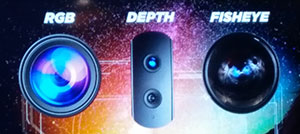
tango-sensorsLenovo’s still working out a lot of the details, but it was able to share some key specs of its Tango phone. Look for the handset to come in somewhere in the lower-six-inch space, be powered by a Snapdragon SoC, and feature a trio of Tango-enabling sensors: those include a traditional camera, a depth sensor, and a wide-angle lens. All that tech demands some special design considerations, and Lenovo intends to give its phone a mechanical heat-dissipation solution to help keep those components cool.
The Tango phone – and no, that’s probably not the name the phone will launch under – will sell in markets around the world, including the US. Lenovo has yet to set the final price, but says that we should see it arrive for under $500. Development work is set to conclude this summer, so chances are we’ll be hearing more about sales plans in just a few months.
What will you do with a Project Tango smartphone? There’s a ton of potential here, from augmented-reality gaming, to planning your next furniture purchase – while getting to see just where everything would fit before you even head to the store. That’s not even touching on use-cases related to navigation, and Tango could very well revolutionize how we find our way around indoors in much the same way GPS has become an essential tool for plotting courses outside.

Source: Lenovo